

A key UNESCO meet on safeguarding intangible cultural heritage (ICH) being held at Delhi’s Red Fort ends on Saturday (December 13, 2025), with the panel adding 67 new living heritage elements from various countries during the nearly week-long session.
The next session of the Intergovernmental Committee (IGC) for the Safeguarding of the Intangible Cultural Heritage will be hosted in December 2026 in China’s Xiamen city, a senior official of UNESCO said on Friday.
The closing ceremony was hosted in the evening by India at the temporary pavilion, Plenary Hall, at the fort complex, as delegates will head out for sightseeing on Saturday after days of intense discussion.

The session was held for the first time in India with the Red Fort, a UNESCO World Heritage Site, as its venue.
Fumiko Ohinata, Secretary, UNESCO 2003 Convention for the Safeguarding of the Intangible Cultural Heritage, in her address at the ceremony, described the Mughal-era fort complex as a “magnificent backdrop” for the meeting.
The Mughal-era monument is famous for its massive fortified walls. “We enjoyed all India moments,” Ohinata said.
Later, interacting with PTI, she said the next session of the IGC will be held in China.
Sixty-seven cultural elements, including India’s Deepavali, Iran’s art of mirror-work in Persian architecture, the UAE’s traditional art form that blends performing arts with oral tradition and Switzerland’s yodelling, have been added to UNESCO’s various intangible heritage lists over the period of December 9-11.
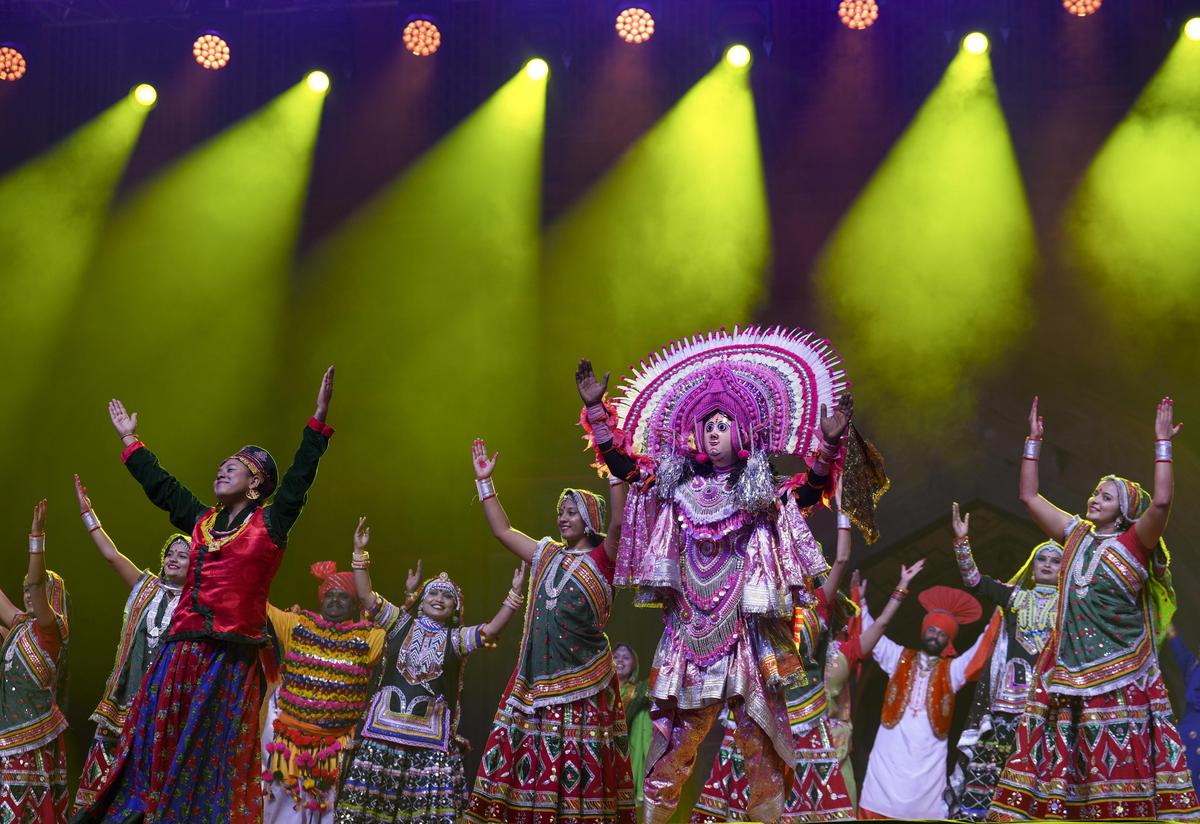
Artists perform a traditional dance during a cultural programme at an event marking the UNESCO Intangible Cultural Heritage inscription of ‘Deepavali’
| Photo Credit:
PTI
Nominations were sent by nearly 80 countries.
In a statement, UNESCO said over the course of the week, the 24 member states of the committee examined 67 living heritage elements, including, 11 elements inscribed on the List of Intangible Cultural Heritage in Need of Urgent Safeguarding; 53 elements inscribed on the Representative List of the Intangible Cultural Heritage of Humanity; and one programme selected on the Register of Good Safeguarding Practices of Intangible Cultural Heritage.
Furthermore, in response to the positive impact of the safeguarding measures put in place since their inscription, two elements have also been transferred from the List of Intangible Cultural Heritage in Need of Urgent Safeguarding to the Representative List of the Intangible Cultural Heritage of Humanity, and their corresponding safeguarding programmes have been added to the Register of Good Safeguarding Practices.
With this year’s inscriptions, 849 cultural practices in 157 countries are now part of UNESCO’s living heritage lists, UNESCO said.
“Fragile yet essential, living heritage remains a pillar of cultural diversity in a world that can at times feel fragmented and divided. Living, creative, and carried by communities, it reminds us of what binds us together,” UNESCO Director-General Khaled El-Enany was quoted as saying in the statement.
“Let us keep alive the hope that unites us today: to share knowledge, strengthen connections, and build bridges across borders,” he said.
The 20th session of the panel began on December 8. The opening ceremony was held on December 7, with External Affairs Minister S Jaishankar attending it as the chief guest.
“We have reaffirmed the extraordinary diversity, creativity, and living wisdom of communities across the world. Each inscription is not merely an addition to a list but a renewed commitment to safeguarding practices that give meaning, identity, and continuity to human societies,” India’s Ambassador and Permanent Delegate to UNESCO, Vishal V Sharma, said in his address at the closing ceremony.
Union Culture Secretary Vivek Aggarwal said this session has reaffirmed the significance of intangible heritage in “sustaining communities, nurturing continuity and fortifying social cohesion, particularly at a time when globalisation, conflict and climate pressure challenge our cultural ecosystems”.
UNESCO said that with over 1,400 participants, this session of the committee was the largest to date, reflecting the growing importance attached to the safeguarding of intangible cultural heritage.
Among the elements presented this year, nine were multinational inscriptions submitted by 28 countries.
“This 2025 session also marked the first inscription for seven countries — Barbados, Chad, the Comoros, El Salvador, Gabon, Libya, and São Tomé and Principe.
“These inscriptions reflect the growing role of the convention in strengthening dialogue and cooperation between states, as well as their shared ambition to promote the safeguarding of living heritage,” it said.
Africa’s continuous commitment was confirmed at this session with the inscription of nine elements by 13 countries, UNESCO said.
Marlen Meissner, member of the German Commission for UNESCO, said she will go back to her country with beautiful memories.
“It would be the people and the richness of culture, the different traditions we’ve seen here… So, it’s the warm-heartedness and the diversity of people (we will take back home),” she told PTI.
Her colleague at the German Commission for UNESCO, Nina Dederichs, described Red Fort’s architecture as “breathtaking” and said she enjoyed her time in India, visiting local markets and sampling Indian cuisine.
Published – December 13, 2025 09:06 am IST